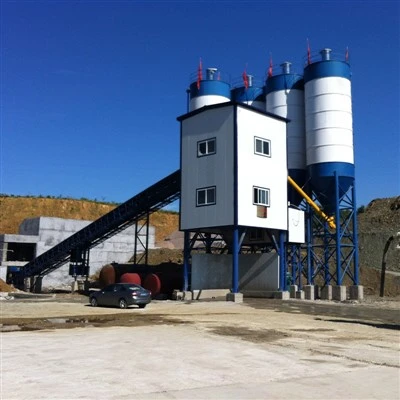
If you’ve ever driven past a big road construction site or watched a skyscraper go up, you’ve probably seen a massive, fixed set of equipment parked on the job for months at a time. That’s a stationary concrete batching plant — and if you’re in the market for one (or just curious how it all works), this post is for you. Concrete Batching Plant

Let’s break it down simply, no industry jargon that makes your eyes cross. First off, what even is it? Unlike mobile batching plants that you can tow from site to site in a day, a stationary model is built to stay put at one location for long stretches. It’s like a permanent, high-powered concrete “factory” right on the worksite, designed to mix consistent, high-quality concrete in huge quantities — way more than you could with a small, portable mixer.
I’ve been selling these things for years, so I can tell you straight up: folks mix them up all the time with mobile units. Let me clear that up right now. A mobile batching plant’s whole thing is portability. If you’ve got multiple small projects spread across a city or state, mobile is perfect — you hook it to a truck, drive it to the next spot, and get mixing. But stationary? That’s for big, long-term jobs: think highway interchanges, huge housing developments, high-rise apartments, or dam construction. You’re not moving it every week — you leave it there for 1, 2, even 5 years, pumping out concrete as needed. That’s why they’re built heavier, more robust, and way more efficient for volume work.
Now, how does it actually work? Let’s walk through the process step by step, like we’re watching it in action. First, you’ve got the raw materials: cement, sand, gravel (that’s the “aggregates”), water, and additives. All of these get stored in separate tanks or bins right at the plant. Cement goes into a vertical silo, sand and gravel into big, open or closed hoppers, water into a separate tank, and additives (like things that make concrete set faster or resist water) get their own small containers.
Here’s where it gets precise — and this is why the quality is way better than mixing by hand or in a small mixer. The plant uses a computer control system (we call it the “PLC,” but I’ll just say computer for now) to measure every single ingredient exactly. No guessing, no “eyeballing” how much sand to add. The system weighs each material down to the gram, then dumps them into a big mixing drum. Some plants use twin-shaft mixers, which are super fast and mix everything evenly in like 30 seconds; others use drum mixers, which are a little more low-key but still consistent. Once it’s mixed, the concrete gets sent out via conveyor belt or chute to the jobsite, straight into the forms for whatever you’re building.
Now, why would someone choose a stationary batching plant over other options? Let’s list the perks, because that’s what buyers care about. First, high production capacity. A typical stationary plant can make 60 to 120 cubic meters of concrete per hour — some even go higher, up to 200 cubic meters. If you’re working on a project that needs thousands of cubic meters over a year, that speed is non-negotiable. You can’t afford to wait for a small mixer to catch up.
Second, cost efficiency in the long run. Sure, the upfront price is higher than a mobile plant, but if you’re staying at one site for a while, you don’t have to pay for transport, setup, and tear-down every time. Plus, the consistency means less waste. Bad concrete from bad mixing gets tossed, so if you’re getting exactly the right mix every time, you’re not wasting materials (which adds up to big savings over time).
Third, reliability. Stationary plants are built to handle heavy, constant use. I’ve had customers run their plants 12 hours a day, 6 days a week, for years without major issues — as long as you do regular maintenance, of course. Mobile units are tough too, but they take more wear and tear from being towed around, so they break down more often. For a big job where downtime means missed deadlines and lost money, that reliability is huge.
Wait, but are there downsides? Let’s be real, I’m not here to sell you something that doesn’t fit. The big one is, well, stationary means you can’t move it. If your project wraps up earlier than expected, or you need to shift to another job, you’re stuck arranging to dismantle and move it — which is expensive and a hassle. Also, it needs more space. A mobile plant fits in a spot the size of a big parking lot, but a stationary one needs a dedicated area for silos, hoppers, the mixing unit, and storage. If your site is tight, that’s a problem.
Now, what should you look for when you’re shopping for a stationary concrete batching plant for sale? Let’s break this down like I’d tell a first-time buyer.
First, production capacity. Don’t buy a plant that’s too small for your needs. If you’re doing a highway project that needs 100 cubic meters an hour, don’t get a 60 cubic meter model — you’ll get stuck. But also, don’t overbuy. If your project only needs 80, a 120 is just wasting space and money. Match the capacity to your project’s peak demand.
Second, the control system. This is the brain of the whole thing. Some plants have basic manual controls, but most modern ones have automatic PLC systems that let you program different concrete mixes. If you need multiple types (like regular concrete for foundations, high-strength for columns), you want a system that can switch between mixes quickly. Also, make sure the control system is easy to use — you don’t want to hire a fancy engineer just to run it.
Third, mix quality. Not all mixers are equal. Twin-shaft mixers are great for high volume and even mixing, but drum mixers are cheaper and simpler. Ask about what kind of mixer comes with the plant, and check customer reviews — a plant that mixes uneven concrete is a disaster waiting to happen.
Fourth, maintenance and support. This is where a good supplier matters. Some cheap plants on the market are made with flimsy parts, so they break all the time and you can’t find replacement parts fast. Make sure the supplier you’re buying from offers local support, can send technicians to fix issues if they pop up, and has easy access to parts. I see so many buyers go for the cheapest option first, then regret it when they’re stuck with a broken plant and no way to get it running.
Fifth, environmental stuff. A lot of construction sites have rules about dust and waste now. Look for a plant that has dust collectors on the silos, so sand and cement don’t blow all over the site (which is not just bad for the environment, but also a hassle to clean up). Some plants also have systems to recycle water and leftover concrete, so you’re not wasting as much.
Now, let’s talk about who uses these plants. It’s not just big construction companies. We sell to housing developers building 500-unit neighborhoods, road contractors doing state highway projects, even mining companies that need concrete for mine infrastructure. Any project that requires a lot of concrete over a long period is a good fit. If you’re a small contractor with one job that only needs a few hundred cubic meters, a mobile plant might be better — but if you’re a bigger outfit with ongoing large projects, stationary is the way to go.
I get it, buying a plant is a big decision. It’s not like picking a new tool for your truck — it’s a big investment, and you want to make sure you’re getting something that works for you. A lot of first-time buyers worry about installation, too. Most stationary plants come with full setup guides, and good suppliers will help you arrange delivery and installation on site. You just need to have the space set up before they get there — level ground for the silos and mixer, power for the control system.
Wait, let’s address a common question: “Can I use a stationary plant for small jobs?” Technically yes, but it’s not practical. The startup time, setup, and space you need just don’t make sense for a 100-cubic-meter job. It’s like using a semi-truck to pick up groceries — it works, but it’s way more expensive and a pain than using a small car. Save the stationary plant for when you’ve got big, sustained demand.
Another thing: we often get asked about cost. A stationary batching plant for sale can range from, say, $50,000 for a small 60 cubic meter per hour model to over $200,000 for a big 120+ cubic meter unit with all the bells and whistles. That’s a wide range, but it’s all based on capacity, quality of parts, control systems, and features like dust collection. Don’t shop by price alone — go with a plant that fits your needs and has a good track record.
Now, if you’re in the market, here’s my advice: don’t rush it. Do your research, figure out exactly what you need (how much concrete per hour, what type of mixes you need, how long you’ll be at the site), and reach out to a reputable supplier. A good supplier will ask you all these questions, not just push the most expensive plant on you. They’ll tell you if a stationary plant is even the right fit, or if a mobile one would be better.
At the end of the day, a stationary concrete batching plant isn’t just a piece of equipment — it’s the backbone of a big construction job. Without consistent, high-quality concrete, you can’t build a solid highway, a safe apartment building, or any of the things we use every day. That’s why it’s so important to get the right one for your needs.
If you’re ready to talk through your project, need a quote, or just have more questions about what stationary plants can do for you, don’t hesitate to reach out. We’re here to help you find the right setup, not just make a sale.
Ribbon Mixer references
- American Concrete Institute. (2022). Guide to Batching, Mixing, and Placing Concrete. ACI 304R-22.
- Construction Industry Institute. (2021). Stationary Concrete Batching Plant Performance and Maintenance Best Practices. CII Report 376.
- National Ready Mixed Concrete Association. (2020). Mobile vs. Stationary Batching Plants: Selection Criteria for Construction Projects. NRMCA Technical Bulletin.
- Concrete Plant Manufacturers Bureau. (2023). Specifications for Stationary Concrete Batching Plants. CPMB Standard 100.
Zhengzhou Tongding Machinery Equipment Co., Ltd.
Zhengzhou Tongding Machinery Equipment Co., Ltd. is one of the most professional concrete batching plant manufacturers and suppliers in China, featured by quality products and good price. Please rest assured to buy CE approved concrete batching plant made in China here and get quotation from our factory. Also, customized service and 5 years warranty are available.
Address: Kexue Avenue Industrial Park, Xingyang City, Zhengzhou City, Henan Province
E-mail: admin@tongdingmachine.com
WebSite: https://www.td-machinerygroup.com/
